Structural response
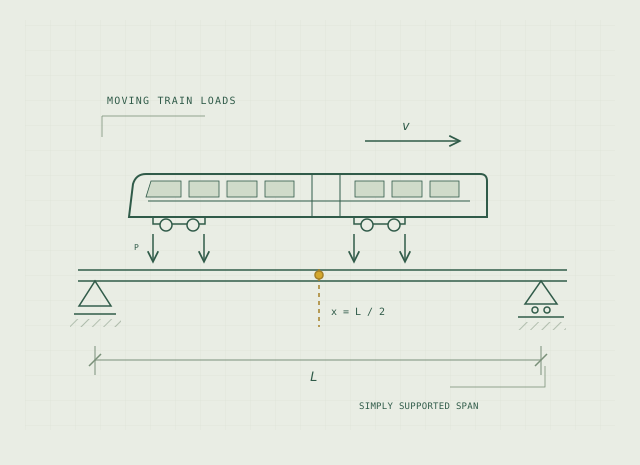
The engine supports modal, moving-load, vehicle–bridge interaction and static calculations, including train-speed sweeps.
AIVN360 / Flagship product
Railway-bridge dynamics.
From model assumptions to inspectable results.
Our first flagship product focuses on the dynamic response of railway bridges under moving trains. KD-Railway, our Rust computation engine, produces structured numerical output, and its development repository documents comparisons with reference calculations.
What exists today
The engine supports modal, moving-load, vehicle–bridge interaction and static calculations, including train-speed sweeps.
Versioned output carries source-engine information and units, providing a foundation for engineering applications and reviewable workflows.
The development repository, which is not public, documents comparisons with a corrected Python reference and an independent finite-element model. These are recorded results, not re-run for this website; their scope and limits are described with the reference case below.
Reference case / Recorded software fixture
The values below come from a committed RailDyn regression fixture for HSLM-A1 moving loads. They make the implemented computation concrete while keeping its scope explicit.
Values at the precision printed in the fixture.
On a narrow screen, scroll the table horizontally to see all four columns.
| Train speed km/h | Peak displacement mm | Peak acceleration m/s² | Dynamic amplification factor |
|---|---|---|---|
| 200 | 4.773 | 1.555 | 1.239 |
| 250 | 4.753 | 1.301 | 1.234 |
| 300 | 7.311 | 4.852 | 1.898 |
The largest displacement and acceleration in this three-point sample occur at 300 km/h. The result applies to this model and these sampled speeds.
Recorded fixture from the engine revision pinned by the inspected RailDyn application: 6aa250ce8331 (v0.2.0). These are committed reference values, not a newly executed simulation.
Input: moving_sweep.json. Output: the HSLM-A1 envelope fixture for the model above. Download the data and full provenance (JSON).
A regression fixture helps detect changes in software behavior. It does not establish suitability for a particular bridge, compliance with a design standard or validation for engineering design use.
Engineering use requires appropriate model selection, independent verification and qualified professional judgment.
Development direction
AI can help engineers organise the work. The numerical model must remain inspectable.
AIVN360’s direction is to connect agents with deterministic engineering computation: preparing inputs, navigating technical information and explaining results with their assumptions intact.
Today, the numerical engine is the foundation. The next step is to make its inputs, results and verification evidence easier to use together in engineering workflows.
KD-Railway is the current public name of the Rust engine behind RailDyn. It builds on CALDINTAV, developed by the Computational Mechanics Group (GCM) at the Technical University of Madrid (UPM). The inspected engine repository includes GPL v3 licensing. Our development work includes corrected formulations and a Rust implementation.
The example above retains its recorded source revision and values. It is software verification evidence, not a new simulation, a claim of exclusive invention, institutional endorsement or validation for engineering design use.
RailDyn enquiries
We welcome conversations with engineers,
researchers and potential collaborators.