Engineering software
RailDyn: will this bridge take a high-speed train?
Bridge engineers on high-speed lines have to show that a bridge behaves under every standard train at every speed it might see. RailDyn runs that whole sweep and puts the answer on one page.
- 470train and speed cases in one sweep: ten HSLM trains at 47 speeds from 120 to 350 km/h
- < 1 sfor that sweep on RailDyn-core, measured from the engine log
- 23cases checked against an independent finite-element model
The problem
Eurocode EN 1991-2 asks for a dynamic check of railway bridges on lines above 200 km/h. The engineer runs ten standard high-speed load models, HSLM A1 to A10, across a range of speeds, then compares deck acceleration, deflection and natural frequency against the limits in EN 1990.
Done by hand or with general-purpose software, that is hundreds of runs to set up and read through. The answer an engineer actually needs is short: up to what speed is this bridge fine, and which train governs?
What RailDyn does
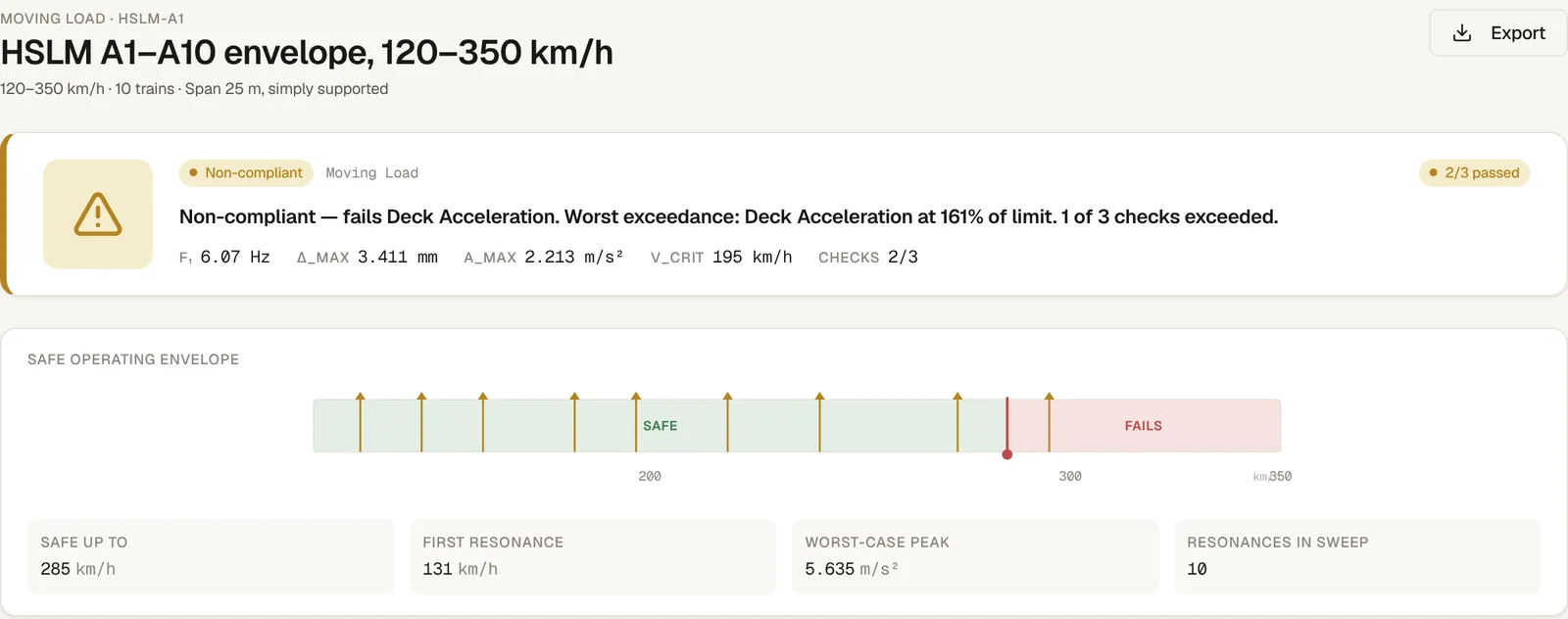
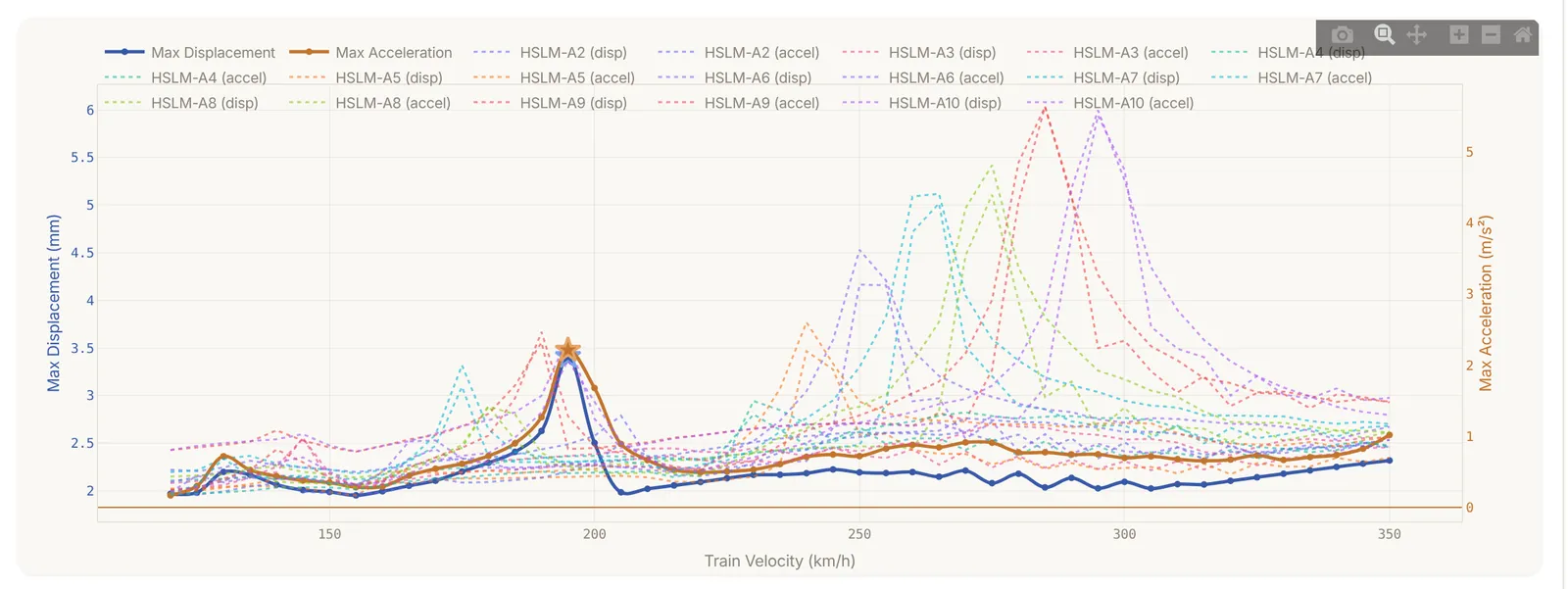
You describe the bridge and choose the trains and speed range. RailDyn runs every case and returns one page with the verdict, the safe speed envelope, the governing train and the response curves for all ten trains.
In the sample run above, the bridge is safe up to 285 km/h. HSLM-A9 governs, and its deck acceleration reaches 161% of the limit, so the check fails. That is the sentence an engineer needs to write in a report, and the page shows the numbers behind it.
Under the hood
Calculations run on RailDyn-core, an engine written in Rust. Each result records the engine version and the inputs it was run with, and the engine never falls back silently to another method.
Speed matters because engineers rerun the sweep every time the design changes. A sweep of ten trains at 65 speeds takes 0.43 s on RailDyn-core, against 40 s for the earlier Python version.