
Approach
We start with the whole system.
Most AI projects that disappoint were aimed at one tool or one task. Real change happens when the people, processes, data and decisions around that task change together. That is where we start.
Seeing the organisation as a system
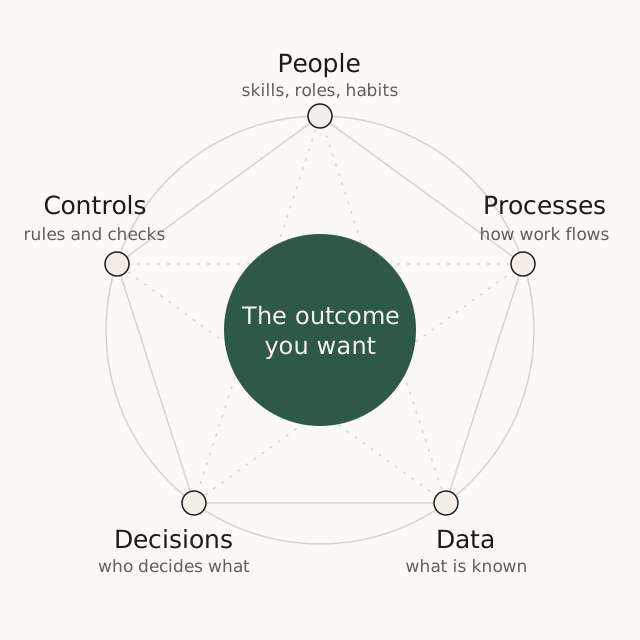
Before we recommend anything, we map five things and how they connect: the people who do the work, the processes they follow, the data they rely on, the decisions they make, and the controls that keep it all safe.
A change to one part ripples through the others. An assistant that answers questions changes who people ask. Automating a report changes who checks it. Designing with the whole map in view is what makes a change stick.
How a project runs
We learn how the work really happens
We talk to the people who do the work and look at the data and tools they use. Then we agree on what better looks like.
We design the change
The target picture: what the system should do, what stays with people, which rules apply, and how we will know it works.
We prove it early
A working pilot on your own data, early. You judge it by using it, not by reading a proposal.
We govern it and help it grow
Rules, training and handover, so your team can run the system with or without us, and extend it to the next part of the work.
How we keep AI trustworthy
AI is very good at language: finding the right document, drafting text, explaining a result, turning a request into a task. It is not a reliable source of facts or of exact numbers on its own. So we design every system around three principles.
Every answer shows its source
When an assistant answers, it says where the answer came from. When there is no source, it says so instead of guessing.
Checks run the same way every time
Where a result matters, such as a design check, a model review or a compliance test, it comes from a fixed, tested process. AI can choose the process and explain the result, but it doesn't change how the process runs.
People make the decisions
AI prepares, drafts and explains. A person with the right role accepts the result, and that acceptance is recorded.
We work this way ourselves
We are building a shared workspace where our own team works alongside AI agents. Tasks, discussion and review sit in one place. An agent can act only when a person allows it, within a fixed budget, and nothing an agent produces counts until a person has accepted it.
Using AI under the same rules we recommend keeps our advice practical. We know where it helps, and where it still needs a careful human eye.
Working with us
- Your data stays yours. We work in your environment where that matters, use your data only for your project, and agree in writing how it is handled before work starts.
- Clear ownership. Who owns the code, the models and the documents we produce is agreed in writing at the start.
- No lock-in. We are not tied to one AI provider, and we hand over documentation and access so your team can run the system without us.
- Fits what you have. We connect to the document systems, models and databases you already use, rather than asking you to replace them.
- Plain answers. If something isn't worth building, or AI isn't the right tool, we say so.
See how this would work for you
Tell us about one process or project. We'll walk you through how we would approach it.